George’s contraband grass
Three Bags FullGeorge’s contraband grass is the concealed cannabis that turns an apparently modest shepherd’s life into part of a larger smuggling enterprise. Hidden in packets carried by the sheep and in a cache beneath the dolmen, it is at once a commodity, a source of danger, and—because the flock takes the human word for grass literally—a revealing test of how differently sheep and people read the same material world.
Appearance and Misrecognition
For the sheep, the substance first becomes legible through smell and taste rather than human categories. When Rebecca opens a packet from the hidden box, she sniffs its contents, and the flock does likewise. Its scent seems strange but appetizing to them; Mopple the Whale immediately recognizes that it can be eaten. Rebecca identifies it aloud as grass, but the word does not mean the same thing to her listeners. The sheep understand the material as feed, while the humans’ eagerness to possess it has another explanation entirely.
That misunderstanding has a history. George Glenn had taken the flock to another pasture for a few weeks on repeated occasions, announcing the trip as Operation Polyphemus. Each sheep carried a small, string-tied packet beneath its belly, buried deep in its fleece. The packets smelled of nothing, and the sheep had no reason to suspect that they held anything noteworthy. In retrospect, the routine of moving the flock had made the animals unwitting carriers: the sheep had physically borne the contraband without understanding either its identity or its purpose.
The Smuggling Operation
The cache beneath the dolmen shows that the packets were only one part of a wider operation. Rebecca uncovers many small packages, a larger, squarish package, and a file of papers, then carries the materials back to George’s caravan. The distinction between the packets and the larger package matters: the hidden supply is not simply a single stash of sheep feed, but an organized collection accompanied by records and another concealed item.
The human conversation around the caravan supplies the commercial context. A man describes George as one of the firm’s best operatives, specializing in consignments to Ireland and Northern Ireland, and says his work had been full of ideas and free of incidents. He explains that the business dealt mainly in grass, but also sometimes in cigarettes and other goods demanded by the market. The file Rebecca has found could, he warns, severely damage the firm. In his account, the hidden material belongs to a flexible trade responding to demand, not to George’s visible life among a few sheep and a small holding.
Earlier suspicions about George help explain why the secret could remain concealed. Harry argues that sheep alone could not have kept George financially secure and suspects that the locked space contains drugs. Tom describes boats bringing goods to the beach at night, their cargo being taken up to the caravan, and George driving away in his car the following day. Beth, meanwhile, recalls that George sometimes possessed expensive things despite the unassuming way he lived, including a costly watch he wore while sowing radishes. These details do not all establish the contents of the cache by themselves; taken together with the packets and the firm’s account, they place the contraband within a concealed business that ordinary pastoral appearances had obscured.
Discovery and Human Stakes
The substance also exposes how the smuggling business intersects with competing claims on George’s land. Harry fears that discovery of the drugs will destroy plans for a dolmen attraction, pony rides, a Celtic cultural center, whiskey specialities, and a seaside hotel. His concern is not only the illicit trade itself, but the prospect that it will draw attention and obstruct development. Tom, by contrast, defends George’s obstruction of tourists and property interests by claiming that George was already making money from night-time deliveries. The grass therefore sits at the crossing point of several forms of value: criminal profit, tourist development, and the land George had kept from would-be commercial use.
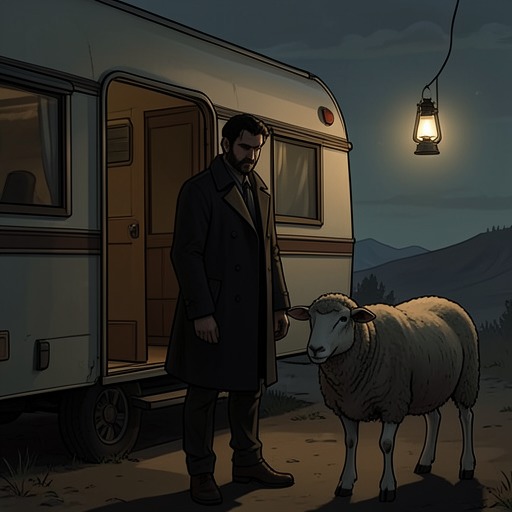
Rebecca’s discovery makes that concealed history personal. After gathering the packets, the larger package, and the papers, she remains out of sight in the caravan before returning to its steps, where a glowing point appears between her lips and sweet, heavy smoke drifts over the meadow. The sheep grow sleepy. Soon afterward, Rebecca tells them a story about a girl with a secret father who planned to travel to Europe, but died while waiting for her to meet him. The account gives the cache’s revelation an intimate consequence: the evidence of George’s hidden trade emerges in the same stretch of the story as Rebecca’s estrangement and grief, not as an impersonal criminal disclosure alone.
Recovery and Meaning
The cache’s contents become tangible again when the firm’s representative arrives. Rebecca reports that one packet is missing because a sheep ate it; the man looks at Mopple the Whale and accepts the loss as the cost of doing business. He counts the recovered packets, deducts the missing one, and declares the delivery complete. He also takes the file and the rectangular package, which Rebecca identifies as a videocassette. The transaction closes the immediate inventory of the stash, but it does not erase what the objects have disclosed: George’s flock had served as carriers, the caravan as a point in the route, and the papers as a threat to the firm.
The grass’s most pointed irony lies in the gap between its names and uses. To the flock, it is edible matter whose smell promises food; to the humans, it is contraband moved through a market and guarded as evidence. Mopple’s eating of a packet turns that difference into an actual loss the representative must count, while the sheep’s earlier transport of packets shows how close their everyday life had been to the operation all along. George’s contraband grass thus makes the pastoral landscape double: the pasture remains a place of grazing, but its animals and familiar structures have also been drawn into a concealed commercial route.